
Young County Release Records
The official Young County jail tool is called the “Current Jail List.” That name sets a firm boundary. It shows people whom the Sheriff’s Office reports in county custody as of the list date, not a complete history of Young County released inmates. Once a person leaves, the name may vanish. The lasting proof is the booking and release sheet, a jail movement entry, and the related court record. Those sources can separate a walk-out release from a transfer that simply ended county custody.
Young County Jail is the county’s one documented correctional institution. Graham and Olney police can make arrests, yet people booked into the county jail remain in the sheriff’s custody system. No TDCJ prison, federal prison, or ICE detention center is physically located in Young County. A Young County case can still move into any of those systems. The agency holding the person after the move determines which search or records office comes next.
- Release
- The end of custody by one agency, which may mean entry into the community or transfer to a new custodian.
- Time served
- Time already spent in custody or a completed term satisfies the custodial part ordered by the court.
- Parole
- A TDCJ releasee serves the rest of a state sentence under Parole Division supervision.
- Discharge
- The sentence ends after incarceration, parole, mandatory supervision, or community supervision is complete.
Young County Custody Exit Types
A roster deletion is not a release type. Young County records should supply the actual reason, legal authority, and destination. Bond normally permits pretrial freedom while the case continues. A dismissal can remove the basis for custody, but another hold may remain. Parole and mandatory supervision concern a state prisoner, while probation is a court order administered through a local community-supervision department. Transfers continue custody elsewhere.
| Exit type | What it means | Where to verify next |
|---|---|---|
| Cash, surety, or personal bond | Pretrial release with the case still open | Sheriff release sheet, court bond order, and Bond Supervision when assigned |
| Time served or county sentence complete | The local custodial term has been satisfied | Judgment, jail-time recital, and sheriff release time |
| Dismissal | A court disposition may remove one custody basis | Clerk docket plus checks for other cases or holds |
| Probation | Court-ordered community supervision | Judgment and Young County CSCD |
| TDCJ transfer | County custody ended but state custody began | TDCJ current-inmate search and state records |
| Federal, county, or ICE transfer | Another agency accepted custody | Movement record and the receiving agency’s system |
Death also ends custody, but it must never be called a release. The exact term in the official record matters because “left the jail” does not always mean “went home.”
Fields in Young County Release Records
A useful Young County release record answers four questions: who was booked, when local custody ended, why it ended, and where the person went. The current roster can provide an arrest number before removal. Preserve that number, the PID if shown, the book date, and the court cause number. They narrow the later request and reduce the risk of confusing people with similar names.
| Field | What it shows |
|---|---|
| Full name, DOB, PID | Identity markers used to match the correct booking |
| Arrest or booking number | The jail event tied to the release |
| Booking date and time | When the county custody record began |
| Charge and cause number | The case and court trail associated with custody |
| Bond type and amount | Bond terms, not proof that bond was posted or release finished |
| Release date and time | When Young County custody physically ended |
| Reason or disposition | Bond, time served, dismissal, sentence completion, or another stated basis |
| Authority and destination | The court or agency authorizing the exit and any receiving custodian |
| Hold or detainer | Another agency’s claim that may block a community release |
| Movement and property notation | Transfer detail and any recorded property handoff information |
The roster detail model has a release-date field, but the record observed during research had that field blank because the person remained on the current list. The system also used a no-photo placeholder. A field’s presence does not prove that Young County offers a public archive or a complete image.
Request Young County Release Records
The Texas Public Information Act provides the practical route once a name leaves the current list. The Young County Sheriff’s Office maintains the county jail booking and release material. No special sheriff request form, records-hours schedule, release-record fee table, or promised response time was found. Ask for named existing documents and fields instead of asking staff to research whether someone is “free.”
- Identify the person with full name, date of birth, approximate booking date, and any PID, arrest number, or cause number.
- Write to the Young County Sheriff’s Office. Mark the message as a Texas Public Information Act request and ask for redirection if another approved address is required.
- Request the booking and release sheet, release timestamp and reason, releasing authority, holds, movement or transfer entries, destination, receiving agency, and booking photograph.
- Ask for electronic copies and the releasable portions if some material must be withheld. Request an itemized estimate before chargeable costs are incurred.
- Preserve proof of receipt. The Act calls for prompt production, but it does not promise every request will be completed within ten business days.
Sheriff Travis Babcock
315 N. Cliff Drive
Graham, TX 76450
940-549-1555
Fax: 940-549-0011
t.babcock@youngcounty.org
Government Code Section 552.234 recognizes mail, email, hand delivery, and other approved methods. If estimated charges exceed $40, Section 552.2615 sets an estimate and response process. District Clerk charges are court-record fees and must not be treated as sheriff fees.
Note: A narrow request for existing sheets and movement entries is more useful than a broad request for an explanation.
Young County Bond Release Oversight
Young County publishes a distinctive local bond path. The 90th Judicial District Young/Stephens Counties Bond Supervision office operates at the same North Cliff Drive complex as the jail and sheriff. Cliff Blackstock can be reached at 940-521-6356 or bondsupervision@youngcounty.org. The office deals with bond conditions. It does not replace the sheriff as proof that jail processing ended.
A bond amount on the current roster is only a stated amount. It does not prove payment, acceptance, a signed personal-bond order, or the moment the person crossed out of county custody. Match three events when possible: the court’s bond authority, the sheriff’s release timestamp, and the supervision requirement. A pending charge can remain even after the person returns to the community.
The county’s Bond Supervision page identifies the office and its local contact. It is especially useful when a sheriff release record lists bond and the court order imposes conditions.
Young County Release Court Trail
The court record often lasts after the current jail entry is gone. Young County splits this trail by jurisdiction. County-level criminal matters generally route through the County Clerk and its linked criminal, civil, and probate portal. Felony and 90th Judicial District matters route through the District Clerk. The county-branded public-search site focuses on land, official, and commissioners-court records, so it should not replace the clerk’s criminal case path.
Read docket entries around the jail exit. A bond order supplies legal authority, but processing or another hold may delay physical release. A dismissal resolves a charge, but it may not resolve every case. A judgment may order time served, probation, county jail, state jail, or prison. A commitment can show that custody moved instead of ended. Jail-time language helps explain the sentence but is not always the exit timestamp.
The Young County District Clerk lists split weekday hours and court-copy charges. Current published charges include a per-name search, printed pages, certification, and electronic copies. Verify them before ordering because those costs belong to court records, not jail release sheets.
Can a court order prove the exact release time? Usually not by itself. Pair the legal order with the Young County sheriff’s physical release or movement timestamp.
Texas Law on Young County Records
Texas Government Code Chapter 552 governs public-information access. A precise request names the record, custodian, date range, person, identifiers, and preferred format. Section 552.108 can protect parts of active law-enforcement material, while basic arrest and offense facts receive different treatment. Juvenile confidentiality, medical privacy, victim information, security rules, and court orders can also require redaction or withholding.
Expunction under Code of Criminal Procedure Chapter 55A and nondisclosure under Government Code Chapter 411, Subchapter E-1, are not the same. Expunction can direct covered agencies to return, destroy, delete, or treat records as the law requires. Nondisclosure generally limits public release without destroying every record. An old record’s absence does not prove that either order exists. Official limits must be respected.
Young County Release Count Limits
No official annual release count or average stay was found for Young County Jail. Texas Commission on Jail Standards POP-2 data cannot fill that gap. POP-2 is a first-of-month population snapshot with categories such as pretrial, sentenced, parole violator, federal, state jail, TDCJ paper-ready population, and rated capacity. It measures who is present at one point, not how many people left over a year.
Any POP-2 number must carry its precise report date and category. It should not be multiplied, averaged, or converted into a local release rate. Secondary sources also report differing facility capacity figures, so no unsourced capacity belongs in a Young County release total. The sound answer is that a verified annual flow figure was not published in the reviewed sources.
Find Young County Released Inmates
Start from the last known custodian, not from a general name search. The Young County current list answers whether the county reports someone housed on its data date. An absent name is only a lead. Search exact spelling and identifiers, then follow the sheriff’s own VINELink direction. The release sheet and court trail establish the reason and destination. If the record says transfer, change to the receiving agency’s system.
- Check the official Young County Current Jail List. If the person appears, save the arrest number, booking date, charge, and other identifiers.
- Search Texas VINELink for the same person and Young County supplying agency. Treat a released or out-of-custody status as feed evidence, not a full disposition.
- Call the sheriff at 940-549-1555 and ask for booking number, release date and time, release type, and destination or receiving agency.
- Request the booking/release sheet and movement record in writing when exact documentation is needed or staff cannot give the information by phone.
- Match the cause number in the County Clerk or District Clerk record. Look for bond, dismissal, judgment, commitment, and jail-time entries.
- If the destination is TDCJ, another county, BOP, USMS, or ICE, continue in that custodian’s official system.
The same-day feed question has its own limits on the Released Last 24 Hours page. Young County does not publish a true recent-release feed, so the search path still ends with official records.
Young County Current List Limits
The official jail landing page leads to a NetData form with beginning-booking-date and starting-name inputs. The date is a booking filter. It is not a release-date filter, a daily release list, or a seventy-two-hour archive. Results show current dorm or location information, which further confirms the present-custody purpose. No official refresh promise or post-release retention period was published.
The Young County Current Jail List form shows the actual search boundary.

Its beginning-date field can help locate a current booking. It cannot prove who was released during a chosen time window.
Note: Record the arrest number while a current entry is visible because it makes a later release-record request far more exact.
TDCJ Search After Young County
The Texas Department of Criminal Justice inmate search includes people currently incarcerated in TDCJ facilities only. Its form accepts last name, first name, TDCJ number, SID number, gender, and race. A search needs the last name plus at least a first initial, TDCJ number, or SID number. Exact identifiers are safer than a common name. TDCJ says the search updates on working days and its information is at least twenty-four hours old.
| Search field | Use | Key limit |
|---|---|---|
| Last name | Required for a name search | Exact matching applies |
| First name | At least an initial with last name | Aliases can affect matches |
| TDCJ number | Seven-digit state identifier | Best when already known |
| SID number | State identification number | Useful across state records |
| Gender and race | Narrow a name search | Do not override identifier conflicts |
While a person is confined, the result may show location, offenses, maximum sentence date, projected release date, and parole-review information. It does not retain a public released-person profile. After a prior TDCJ match disappears, use TDCJ’s no-charge email information route at pia@tdcj.texas.gov, telephone status lines, IVSS, Parole Division, and the court record. A blank current search cannot prove the release date or type.
The official TDCJ search screen visibly states its current-incarceration limit.
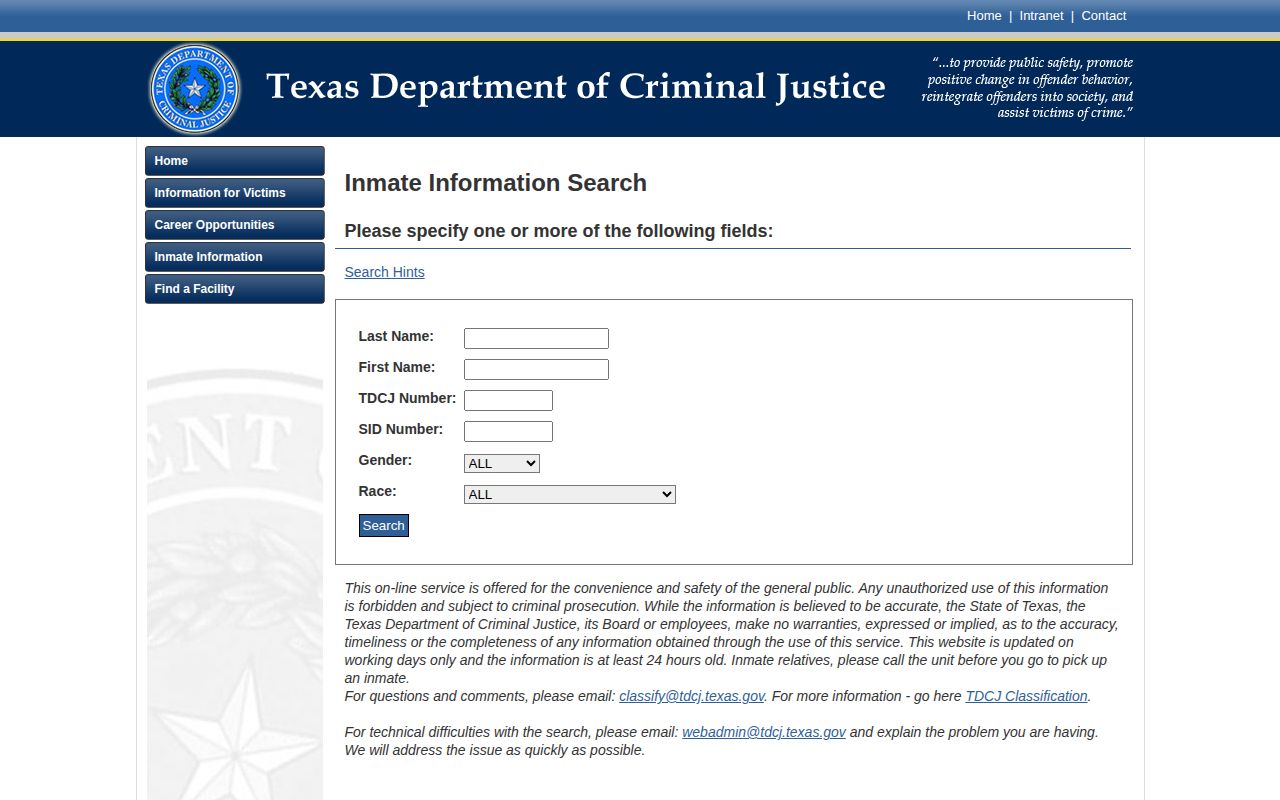
That warning is why a released state prisoner requires TDCJ records or supervision channels rather than repeated searches of the current locator.
Young County Release Supervision
Parole and probation create different trails. Parole follows TDCJ incarceration after a Texas Board of Pardons and Paroles decision. A releasee remains under the sentence and is supervised by TDCJ Parole Division. Young County residents map to the Wichita Falls District Parole Office in Region V, although an individual assignment can change. A favorable parole vote does not prove physical release because a residence review, program, audit, certificate, date calculation, or detainer may remain.
Probation, also called community supervision, is ordered by a court and handled locally. The 90th Judicial District Adult Probation office and Young County CSCD are the local sources. A person released from the county jail onto probation ordinarily will not appear in TDCJ’s current-prison search. The judgment shows the legal order, while the proper supervision office supplies its own lawful status information.
Young County Release Notifications
The Young County Sheriff’s own page directs the public to Texas VINELink for custody-status checks. Search one person, compare identifiers and the supplying agency, then read the status line. A released or out-of-custody result reflects the participating feed. It may not state bond versus time served, the exact exit instrument, or a receiving custodian. Feed timing can also lag. Confirm the key facts with sheriff and court records.
Texas uses a separate system after transfer to TDCJ. The Integrated Victim Services System, or IVSS, can provide notices about parole review, release to supervision, discharge, and supervision-warrant actions. A county VINE registration should not be assumed to follow the person into state prison. Federal criminal custody requires the BOP locator or federal court trail. ICE detention uses ODLS. Each system covers a different agency.
The Texas Public Sex Offender Registry is another limited post-release source when Chapter 62 applies to the person. It is offense-specific, not a Young County released-inmate list, and it does not establish parole, discharge, or the exact county jail exit date.
ICE Holds in Young County Releases
The live Young County roster can display an “ICE DETAINER” label. That local field is concrete proof that removal from the county list may mean pickup, not return to the community. Ask the sheriff for the movement entry, release timestamp, destination, and receiving agency. Then use the official ICE Online Detainee Locator with an A-number and country of birth or exact biographical details.
ODLS is a current or recent detention locator, not a complete Young County release archive. People under eighteen are not searchable, and a missing result has several possible causes. Keep the county transfer record because it proves how Young County custody ended. Civil immigration release, transfer, removal, and ongoing detention are different outcomes.
Federal Releases from Young County
The BOP Inmate Locator covers federal inmates from 1982 forward. It can be searched by BOP register, DCDC, FBI, or INS number, or by name with age, race, and sex filters. Results can show name, register number, age, race, sex, release date, and location. “Released” or “Not in BOP Custody” means only that BOP no longer holds the person. Another government may have custody, and federal supervised release may continue.
USMS has no comparable public historical released-person locator. If Young County records show a USMS pickup, request the local movement date and destination, then use the federal docket and USMS information or FOIA channels. The court record is often the lasting source for detention, release, judgment, and supervised-release orders.
The BOP Inmate Locator supplies the federal custody and release-date fields.
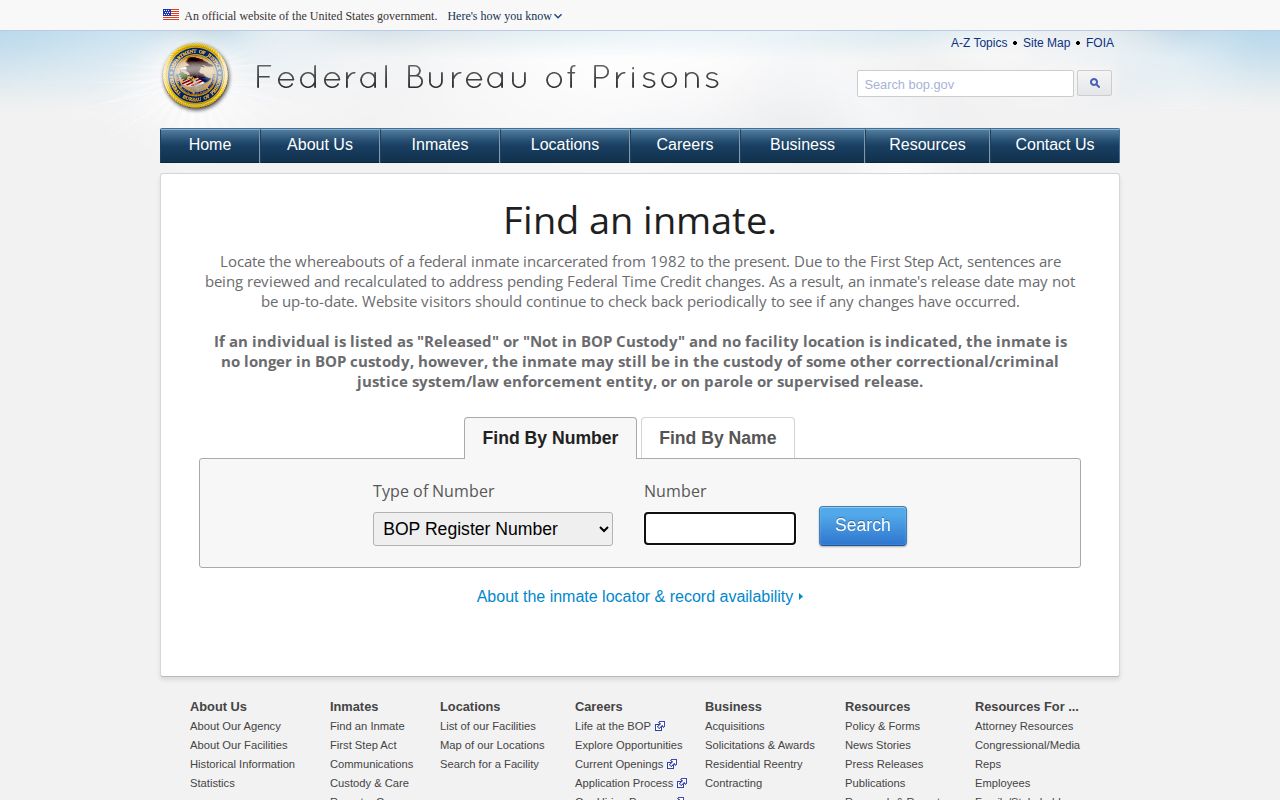
Read its status literally and check any known receiving agency before treating the result as community release.
Young County Custody Search Comparison
The correct portal follows the legal custodian. Current custody and past release are not interchangeable search categories. The table shows the strongest use of each official route and the point at which another record is needed.
| Source | Best use | What it cannot prove alone |
|---|---|---|
| Young County Current Jail List | Current county custody and booking identifiers | A past release, release reason, or destination after removal |
| Sheriff release and movement record | Local exit time, reason, authority, and receiving agency | Later status under a new custodian |
| County or District Clerk | Bond, dismissal, judgment, sentence, or commitment | The precise physical jail exit time |
| TDCJ current search | Present state incarceration and projected date | A durable profile after state release |
| VINELink or IVSS | Status and registered notification within the covered system | Guaranteed timing or every reason and destination |
| BOP or ICE locator | Federal or immigration custody route | Freedom from all other custody or supervision |
Young County Jail Release Context
One secondary local account describes jail inspection deficiencies and a custodial death, while another secondary report describes later concerns involving mental-health documentation and observation. Those reports provide facility context only. They do not prove the custody status, treatment, release, or transfer of any named person. An underlying Texas Commission on Jail Standards record should control if that record is obtained.
Release logistics also remain undocumented in official material reviewed for Young County. No published source gives a standard release hour, exit door, pickup lane, transport service, property process, weekend rule, or gate-money policy. Visitation hours cannot be reused as release hours. Families should call the jail before travel and ask where an authorized pickup may wait and how property will be returned.
Young County Release Facility
Young County Jail, also called the Young County Law Enforcement Center, is the one documented local correctional institution. It holds people booked into county custody even when Graham or Olney police made the arrest. Community outcomes can include bond, dismissal, time served, or completion of a county sentence. Other exits include TDCJ, another county, federal custody, ICE, treatment, or another placement.
There is no TDCJ, BOP, or separate ICE facility in Young County. Nearby Texas prisons should not be described as automatic destinations because TDCJ assigns people statewide based on its own classification and operational needs. The sheriff movement record identifies the first receiving agency. From there, the search must continue in that agency’s official system.