
Young County VINELink Coverage
Young County's official Sheriff page directs people to VINELink to check custody status. That local direction matters. It makes the Texas VINE route part of the county's own published lookup flow, rather than a broad service with no documented county connection. Begin at the Texas state page and search for one person. The supplying agency shown on the result must match the custody event being checked.
VINELink reports data received from participating agencies. For a Young County Jail record, read the status as a report from that feed. A result marked released or out of custody can be strong near-term evidence that county custody ended. It may not say whether release occurred through bond, dismissal, time served, or sentence completion. It may also omit the receiving agency after a transfer. The Young County booking and release sheet remains the better source for the exact time, reason, authority, and destination.
State prison is different. TDCJ's public inmate search lists only people currently incarcerated in a TDCJ facility, and Texas uses IVSS for state prison and parole notifications. Federal BOP custody is not part of Young County VINELink. Immigration custody also has its own federal locator. These systems must be read separately, even when one person moves through more than one of them.
Search Young County VINELink Records
Use exact identity facts whenever possible. Names can be shared, shortened, misspelled, or entered under an alias. An offender or booking number is stronger than a name alone. If only a name is available, compare every identifier the live record offers. Most of all, inspect the supplying agency. A same-name record from another Texas county does not confirm a Young County custody event.
- Open the Texas service. Start at the official Texas VINELink search rather than a third-party listing.
- Select offender search. Use the current state interface and choose the option for a person in custody records.
- Enter exact details. Search by full name or offender or booking ID when the interface offers that field.
- Compare each match. Check available identity facts and reject records tied to the wrong agency or county.
- Open the matched record. Read its supplying agency, custody status, and the date or time attached to that status.
The Texas VINELink search start shown below is the correct state route for a Young County VINELink check.
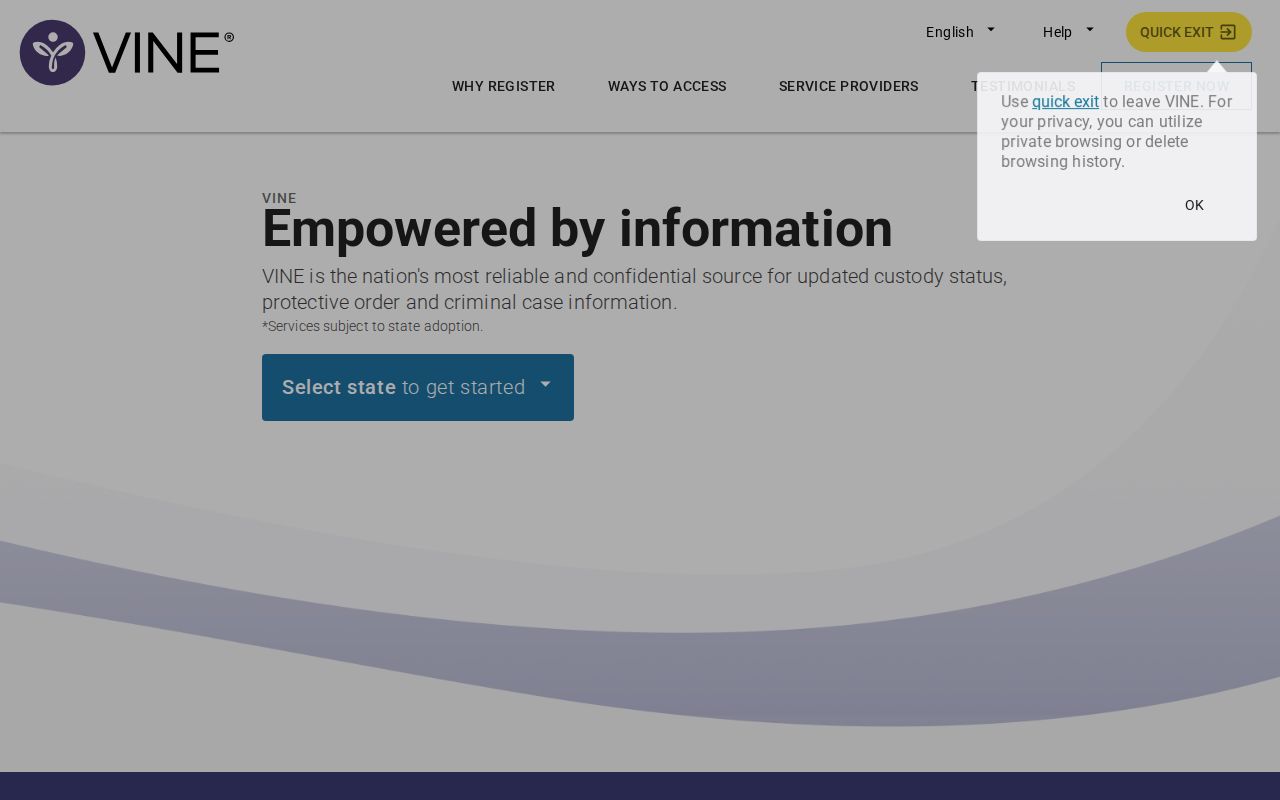
The state screen begins the match, but the record behind the correct supplying agency provides the useful custody detail.
Note: Save the identifiers and displayed status time before making a sheriff request, since the live result may later change or disappear.
Read a Young County VINELink Result
A VINELink result is best read field by field. The person's name and any displayed identifier establish the likely match. The supplying agency identifies the source feed. Custody status indicates what that feed currently reports. A location or facility field may show where the person is held, but it should not be stretched into proof of a future release. The status date or time helps place the event, subject to feed lag.
| Displayed item | How to read it |
|---|---|
| Name and identifier | Use both to reduce the risk of choosing a same-name person. |
| Supplying agency | Confirms which participating jail or agency sent the data. |
| Custody status | Shows the feed's current label, such as in custody, released, or out of custody. |
| Facility or location | May identify the current custodian or last reported place. |
| Status date or time | Places the reported event, but may not equal the sheriff's formal release timestamp. |
| Notification option | Opens registration when notices are available for that person and event. |
Released or out of custody means the participating feed reports that status. It does not, by itself, identify bond versus time served, prove that a charge was dismissed, or exclude transfer to another custodian. A no-result has even less force. It can reflect spelling, coverage, data lag, an archived record, or a transfer. Absence must not be treated as proof of community release.
Register Young County Release Alerts
Notification registration starts from the matched offender record. The live interface controls which channels are available. Common options include telephone, email, text, or an in-app notice. Sign-in or account creation may be required. Enter a destination that will remain available, complete the verification step shown, and retain the confirmation. Recheck the person's identifiers before finishing so the alert follows the intended record.
- Open the correct record. Confirm both identity and Young County supplying agency before selecting notifications.
- Choose registration. Sign in or create an account if the current screen requires one.
- Select offered channels. Add the telephone number, email address, text number, or app destination shown by the service.
- Complete confirmation. For phone notices, follow any four-digit PIN instruction; email and text use the live verification method.
- Keep the receipt. Save the registration confirmation and update contact details when they change.
The official Texas VINELink login and registration route shows the current account flow.
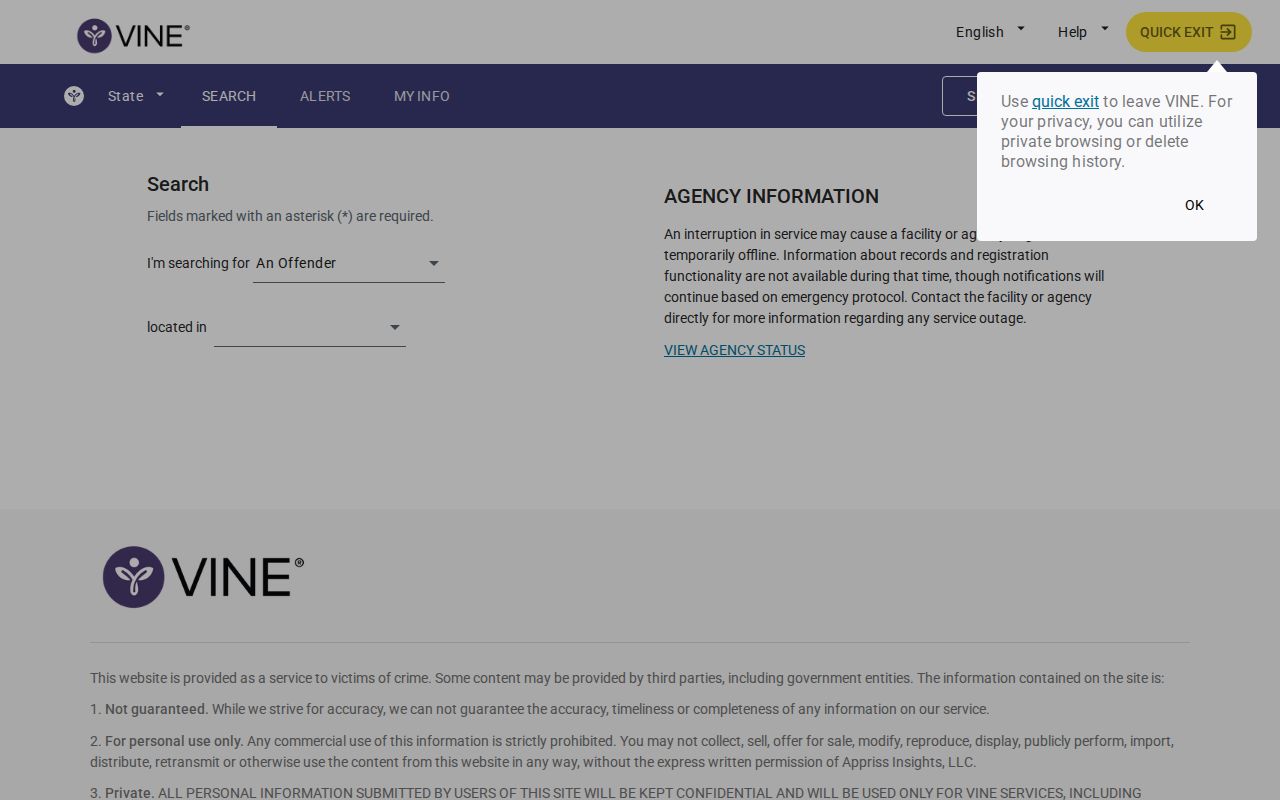
The screen determines the available channels and confirmation method, so users should follow its current prompts rather than assume every alert uses a PIN.
Telephone registrations have traditionally used a four-digit PIN. Automated calls ask for it to acknowledge the notice and stop repeat calls. That does not mean email, text, or app notices always use the same step. Test access if the system offers a test, and never rely on one alert as guaranteed advance warning.
Young County Sheriff's VINELink Route
The page for Sheriff Travis Babcock directly instructs readers to use VINELink, a distinctive Young County feature. The county also publishes a separate Current Jail List. Used together, they serve different functions. The roster can show a person whom Young County currently lists as housed. VINELink can supply an immediate custody-status check when the person is no longer visible. Neither one is a historical county release archive.
A sound local sequence starts with the current list, then moves to VINELink, the sheriff's release or transfer record, and the court disposition. The Young County released inmate records path covers that full chain. When VINELink says released, ask the Sheriff at 940-549-1555 for the booking or arrest number, release date and time, release reason, releasing authority, and destination or receiving agency. If staff cannot provide the record by phone, make a focused Texas Public Information Act request for the booking/release sheet and movement or transfer line.
The current roster's beginning-date field is a booking filter. It is not a released-person date search. Likewise, a blank release-date field on a current detail means only that no release date was populated in that observation. Keeping the function of each source narrow prevents a status check from becoming an unsupported conclusion.
Switch Young County Notification Systems
A transfer from Young County Jail to TDCJ is continuing custody, not release to the community. It also changes the notification system. County-linked VINELink relies on participating local custody data. The Texas Department of Criminal Justice operates the Integrated Victim Services System for state prison and parole events. A local VINE subscription should not be expected to migrate with the person.
IVSS can provide a limited offender search and notices tied to TDCJ Correctional Institutions and Parole Division data. Depending on the record and registration, events can include parole review, release to supervision, discharge, and a supervision-warrant action. TDCJ lists email, letter, text, or combinations as available channels and describes an automated call while an offender is being processed for release. Those state events are broader than the county feed and arise from a different custodian.
| Custody track | Notification layer | Verification source |
|---|---|---|
| Young County Jail | Texas VINELink, when the local record is covered | Young County booking/release sheet and court record |
| TDCJ prison or parole | TDCJ IVSS | TDCJ records, Parole Division, and supervising office |
| Federal BOP custody | No Young County VINE coverage | BOP Inmate Locator and federal record |
| ICE custody | No Young County VINE continuation promised | ICE ODLS and the county transfer record |
The TDCJ IVSS portal pictured below is the separate state-prison and parole notification layer.
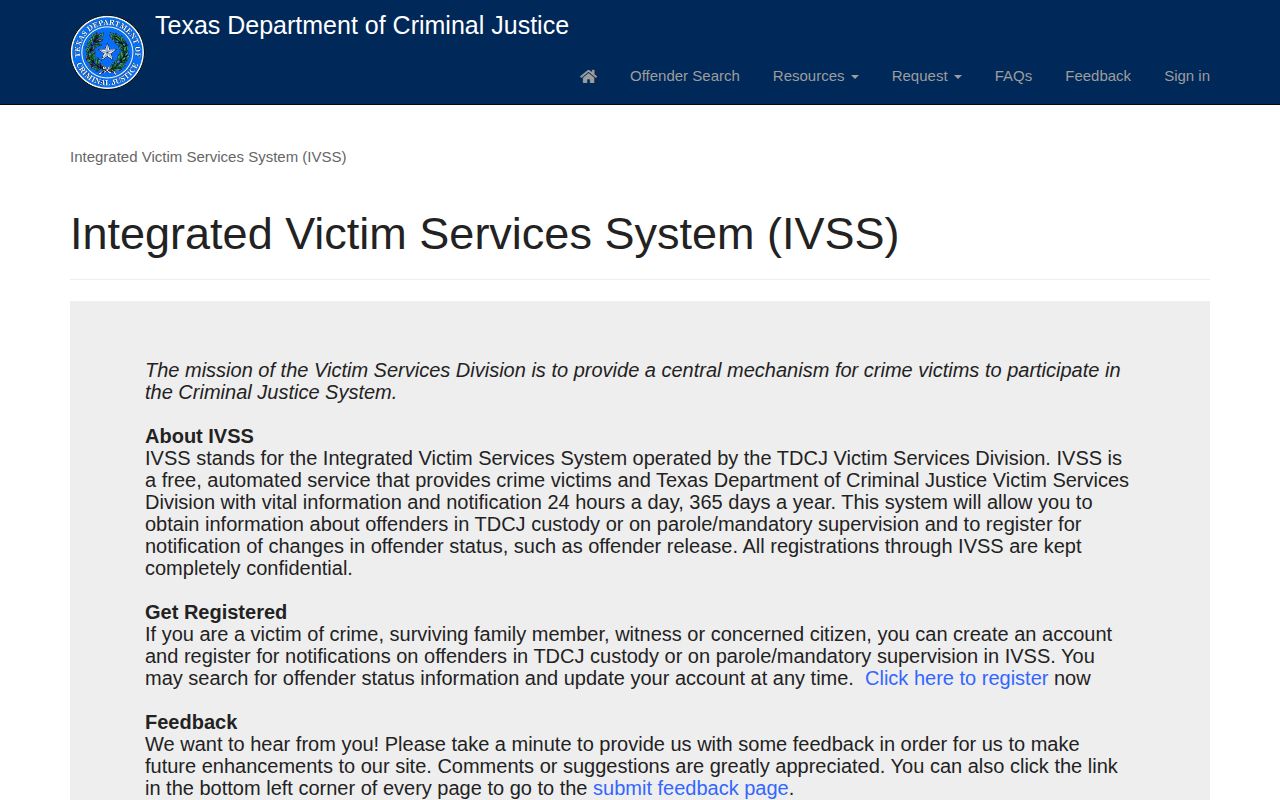
The portal should be used after a TDCJ transfer rather than assuming that a Young County VINELink alert still follows the record.
Young County VINELink Limits
VINELink is not a certified historical archive. Agency participation and feed timing shape what appears. A notice may lag, fail, or arrive after the underlying event. A record may vanish because of archival limits or transfer. A no-result may also come from a name mismatch. For those reasons, VINELink should never be promised as real-time or guaranteed advance warning.
Know the limit: A VINELink status is feed evidence. Confirm the reason, exact time, authority, and destination with the agency record.
County VINE does not track a person in federal Bureau of Prisons custody. The BOP locator may show a federal release date or a status such as released or not in BOP custody. That language only describes BOP custody and does not rule out state, county, immigration, or other federal custody. ICE ODLS is a detention locator, not a Young County release archive. Its no-result likewise does not prove release.
Texas also limits the public TDCJ inmate search to people currently incarcerated in a TDCJ facility. A result can show present location and a projected release date. Once the person leaves the online population, an empty search is only a prompt to use TDCJ information channels, IVSS, Parole Division, or a records request.
Confirm Young County Release Status
Build confirmation from matching records. First preserve the VINELink status, date, and supplying agency. Then match the name and identifiers to the Young County booking. Ask for the existing release sheet and movement or transfer record, not an open-ended explanation. Court records can identify a bond order, dismissal, judgment, or sentence event, though a court order may not show the exact time the jail completed release processing.
If the sheriff record identifies TDCJ, another county, federal authorities, or ICE as the destination, follow that receiving system. The transfer record proves how Young County custody ended. The receiving locator then shows the next custody stage. If the record shows community release, the release reason and court file can distinguish bond from time served, dismissal, or completion of a county sentence.
A clear result answers four points: who supplied the status, which person it matches, what custody event it reports, and when that event occurred. VINELink can answer part of that set quickly. Young County and court records finish the verification when the exact release basis or destination matters.
Note: Keep alert confirmations current, but use direct agency records for decisions that depend on an exact custody or release event.