
Young County Jail Release Paths
Young County Jail, also described locally as the Young County Law Enforcement Center, is the county correctional institution documented in Graham. The Young County Sheriff’s Office operates it. Graham and Olney police can make arrests, but no separate long-term municipal detention facility or municipal released-inmate archive was found. An arresting agency and a custodial agency may differ, so a Graham or Olney arrest can still end with a Young County Jail release record.
Leaving the jail has more than one meaning. A person may enter the community after posting surety or cash bond, receiving a personal bond, having a charge dismissed, receiving credit for time served, completing a county sentence, or receiving a probation-related order. The jail exit can instead continue custody through TDCJ, another county, the United States Marshals Service, another federal authority, ICE, treatment, or another placement. The sheriff’s release and movement entries should identify that distinction.
| Young County jail outcome | What it means | Next record |
|---|---|---|
| Bond or personal bond | Pretrial community release while the case ordinarily continues | Sheriff timestamp, bond order, and court docket |
| Time served or county term complete | The local custodial portion has been satisfied | Judgment, jail-credit recital, and release sheet |
| Dismissal | A case disposition that may support release if no other hold remains | Dismissal order plus actual jail exit record |
| TDCJ or other transfer | Young County custody ended, but custody continued elsewhere | Receiving agency and transfer record |
| Probation disposition | Court-ordered community supervision, distinct from parole | Judgment and Young County CSCD |
A court order may authorize release before physical processing is complete. Another warrant or detainer may still intervene. For that reason, combine the order with the Young County Jail exit time and destination instead of reporting a legal event as the actual moment of release.
Confirm Young County Jail Releases
The official Young County Jail page labels its roster link “Current Jail List.” That title defines the portal’s role. It can show that a matching person is presently listed as of the product’s data date. It cannot supply a reliable historical release archive. Its beginning-date entry is a booking filter, not a recent-release selector, and the list includes a current dorm or location field.
The live list is still useful. Results can supply the name, arrest number, book date, dorm or location, and abbreviated charge. A detail can add PID, identity and physical-description fields, bond amount, book-in date, a release-date element, and an image element. During research, the observed current detail had a blank release field and a no-mug image. Preserve the arrest number and PID before the entry disappears.
- Search the official current list with the correct spelling and compare all available identifiers.
- If the person is listed, read the data date and current location. Do not turn a blank release field into a prediction.
- If the name is absent, search Texas VINELink using the same identity and select the record supplied by the correct agency.
- Call the sheriff with the arrest or booking number and ask for the release time, reason, authority, destination, and receiving agency.
- Use the court docket and any receiving agency to verify the legal disposition and the next custody stage.
The full named-person workflow and release-field inventory are on the Young County released-inmates search page. It also explains how county, TDCJ, BOP, and ICE records differ.
Request Young County Jail Records
A focused Texas Public Information Act request is the main fallback after a person leaves the current roster. Address the request to the Young County Sheriff’s Office, the custodian of the jail booking and release file. Ask for existing records rather than asking staff to decide whether the person was “really released.” That wording preserves the key distinction between a community exit and an agency transfer.
Provide the full name and date of birth, PID, arrest or booking number, booking date and time, and known cause or warrant number. Request the booking and release sheet, movement or transfer entries, charges, bond type and amount, holds, release date and time, release reason or disposition, releasing authority, destination, receiving agency, and booking photograph. Ask for electronic copies and for the releasable parts if another portion must be withheld.
Government Code Section 552.234 permits approved channels such as mail, email, and hand delivery. The sheriff page publishes Sheriff Travis Babcock’s email, but no dedicated records address or sheriff-specific request form was found. If email is used, state that the message is a Public Information Act request and ask for prompt routing if a designated address applies. Preserve proof of receipt. The Act calls for prompt production, not a universal ten-business-day delivery date.
No Young County sheriff copy-fee table was found. The District Clerk’s court-record fees and the sheriff’s service-of-process charges apply to different services, so neither should be quoted as a jail release-record price. Request an itemized estimate before costs are incurred. Active-case material, juvenile information, sealed or expunged records, and other protected matter may be redacted or withheld under current law.
Note: A narrow request for named records and exact fields is easier to process than a demand that the sheriff create a new release report.
Young County Jail Contact
Call before traveling for release pickup or records access. No official release hour, exit door, family waiting point, weekend procedure, transport service, property-return process, or gate-money policy was found. The jail’s visitation schedule is not a release schedule and should not be used as one.
Young County Jail / Law Enforcement Center
Young County Sheriff’s Office
315 N. Cliff Drive
Graham, TX 76450
Telephone: 940-549-1555
Fax: 940-549-0011
Email: t.babcock@youngcounty.org
The official sheriff page supplies the main contact and directs the public to VINELink for custody status. Telephone staff may be able to confirm basic facts, but a written request is the better route when an exact record or statutory processing is needed. Ask where an authorized pickup may wait and how property is returned rather than assuming the answer from a map or visiting-hours notice.
Young County Jail Transfer Records
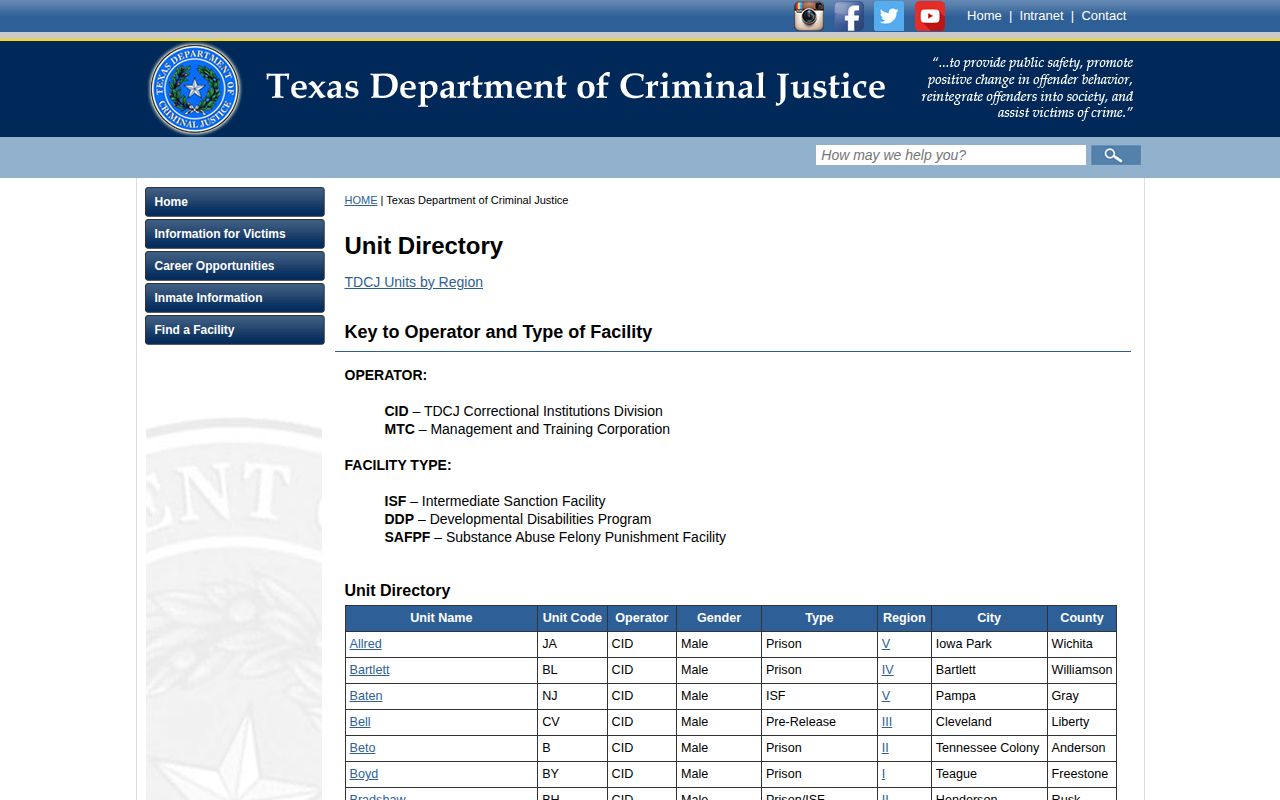
There is no TDCJ prison or state jail in Young County. Nearby units in other counties are not automatic destinations, and TDCJ can assign people statewide based on classification, custody, programs, health needs, and capacity. When the Young County release record says “TDCJ transfer,” search the statewide TDCJ system. The state search applies to current TDCJ incarceration, not the county jail.
The TDCJ statewide unit directory helps establish that facility distinction. The captured directory below is relevant because it prevents a Young County case from being mislabeled as confinement in a nonexistent local state unit.
Federal movement follows a different path. No BOP prison was found in Young County. A county record naming the United States Marshals Service or another federal recipient should be followed through the federal docket, USMS information or FOIA channels, and the BOP locator when applicable. A BOP result marked “Released” or “Not in BOP Custody” describes BOP status only. It does not exclude state, county, or immigration custody.
ICE Detainers at Young County Jail
The Young County current roster can carry an “ICE DETAINER” charge or hold label. That local field is a concrete reason why list removal cannot be equated with community freedom. An ICE detainer may be followed by pickup and a transfer chain. The county release timestamp can show when Young County custody ended, but the receiving-agency and destination entries explain where the person went.
Use the ICE Online Detainee Locator System after a county record identifies immigration custody. ODLS supports an A-number and country-of-birth search or a biographical search with exact name, date of birth, and country of birth. It is a current or recent detention locator, not a complete Young County release archive. A missing result may reflect spelling, identifier, age, time, or coverage limits and does not prove release.
Keep both records. The Young County movement entry proves the local custody transition. ICE status addresses the next stage. Civil immigration release, removal, transfer, and continued detention should not be collapsed into a criminal sentence discharge. If the roster showed a hold but the destination is unclear, ask the sheriff for the receiving agency rather than guessing from the label alone.
Note: An ICE detainer is a transfer warning, not proof that ICE actually assumed custody after the Young County jail exit.
Match Young County Jail Records
The court trail often lasts after the current jail entry is gone. County-level misdemeanor matters generally route through the Young County Clerk, while felony and 90th Judicial District matters route through the District Clerk. Start with the cause number and defendant identifiers from the booking record. Read the docket in sequence around the jail exit.
A bond order establishes legal authority for pretrial release, though processing and another hold may remain. A dismissal may remove one case basis for custody, but a second case can still control. A judgment may impose time served, probation, county jail, state jail, or prison. A commitment often documents movement to another custodian. Jail-credit language helps explain the sentence but may not state the exact physical exit time.
- Release sheet
- The sheriff record documenting the end of Young County custody and the stated reason.
- Movement record
- The jail trail showing transfers and a receiving agency when custody continues elsewhere.
- Cause number
- The court identifier that connects booking charges with orders, disposition, and judgment.
- Receiving agency
- The custodian accepting the person after Young County, which distinguishes transfer from community release.
Probation and parole also diverge here. Probation is imposed by a court and handled locally by a Community Supervision and Corrections Department. Parole follows TDCJ incarceration and is supervised by TDCJ Parole Division after a Board of Pardons and Paroles decision. Neither should be inferred solely from a county roster entry.
Young County Jail History Context
Secondary local accounts describe a custodial death in 2023 and inspection and later compliance concerns involving mental-health documentation and observation. These reports are facility context only. They are not Young County release logs, do not show that a named person left custody, and should not be used to infer a release date, cause, or destination.
The reports also should not replace an underlying Texas Commission on Jail Standards document when a precise inspection finding is at issue. Research captured the accounts as secondary summaries because the underlying report was not captured with them. Any later use should keep that attribution visible and check the primary state record first.
Population figures require the same restraint. Texas Commission on Jail Standards POP-2 material provides first-of-month population categories, not annual releases or average length of stay. Secondary sources give differing jail capacities, so no capacity claim or release-volume estimate is presented as a facility fact. Facility history and population snapshots do not answer the named-person release question.
The defensible answer remains record based: current list, VINELink, sheriff release and movement records, court disposition, and the identified receiving agency. Those sources show custody transitions. Historical reporting supplies context, but never release proof.