
Young County Parole and Probation
Parole follows confinement in the Texas Department of Criminal Justice. The Texas Board of Pardons and Paroles decides whether an eligible person may serve the balance of a prison sentence in the community. After release, the TDCJ Parole Division manages that supervision. Probation, which Texas also calls community supervision, comes from a court order. The 90th Judicial District Adult Probation office carries out that local order in Young County. TDCJ's Community Justice Assistance Division helps fund and regulate local departments, but it does not work directly with a person on probation.
The distinction controls where to verify a status. A TDCJ prison release can lead to parole or mandatory supervision, both handled through the state parole system. A Young County Jail release can instead lead to local probation, bond supervision, dismissal, time served, transfer, or no supervision at all. The current jail list cannot settle that question after a name disappears. Use the judgment and release authority first, then contact the office that owns the resulting supervision record.
| Point | Parole | Probation |
|---|---|---|
| How it begins | BPP approves release from a TDCJ sentence | A court imposes community supervision |
| Young County office path | TDCJ Wichita Falls District Parole Office, Region V | 90th Judicial District Adult Probation in Graham |
| Best starting record | TDCJ number, parole decision, and release certificate | Cause number, judgment, and supervision order |
| How it ends | Discharge, sentence completion, or another lawful action | Court-ordered completion, discharge, or revocation |
- Parole
- Discretionary release approved by BPP while the sentence continues under community supervision.
- Probation
- A court-ordered period of community supervision, often imposed without a completed state-prison term.
- Mandatory supervision
- A statutory release path for eligible people, now subject in many cases to BPP review.
- Discharge
- The end of the sentence or supervision obligation, distinct from release into supervision.
- Absconder
- An agency status that must be confirmed officially, not inferred from a missed meeting or lack of contact.
Verify Young County Post-Release Supervision
Start with identity, not an assumption. Full name, date of birth, cause number, SID number, TDCJ number, and booking number help separate people with similar names. Next determine whether the release came from Young County Jail, operated by Sheriff Travis Babcock's office, or TDCJ. A county judgment may state that probation was imposed. A TDCJ release record or certificate may identify parole or mandatory supervision. If the person is still confined, the TDCJ current-inmate search can show present location and parole-review information, but it is not a durable released-person database.
- Identify the custody path. Match the person to the Young County booking record, court cause, or TDCJ identifier.
- Read the controlling record. Check the judgment, release authority, or TDCJ parole decision for the type of supervision.
- Use the correct office. Contact Young County Adult Probation for a local community-supervision order or the Wichita Falls office for parole.
- Ask a precise question. Provide identifiers and request legally releasable confirmation of active supervision, assignment, or discharge.
- Reconcile any conflict. A jail departure, favorable vote, and supervision start can occur on different dates, so verify each event separately.
The complete county release trail begins with the booking and release sheet and continues through the court record. The Young County released inmate search explains how those records distinguish community release from a transfer. Do not treat a blank TDCJ search result as proof of parole or discharge. TDCJ expressly limits its public search to people currently held in a TDCJ facility.
Important: A favorable parole vote is a decision stage, not proof that the person has left prison or begun Young County supervision.
Young County's Two Supervision Paths
Young County has two offices in different cities because parole and probation arise from different legal paths. The local probation route stays in Graham. The county's 90th Judicial District Adult Probation page identifies the local office, and the current state directory places the Young County Community Supervision and Corrections Department at 512 4th Street, Room 207. The office serves court-ordered probation. The state parole route goes to Wichita Falls. TDCJ maps residents of Young County who are on parole or mandatory supervision to its Region V district office, subject to changes in an individual assignment.
This geographic split is a practical clue, not a substitute for the judgment. Someone released from Young County Jail on a local probation order ordinarily does not appear in the TDCJ current-inmate search. Someone released from a state unit on parole does not become a county probation case merely because the approved residence is in Graham. The release authority decides which office has the record.
90th Judicial District Adult Probation
512 4th Street, Room 207
Graham, TX 76450-2964
940-549-7960
Fax: 940-549-6352
Email: s.wallace@youngcounty.org
Wichita Falls District Parole Office
Region V
3100 Seymour Highway, Suite 118
Wichita Falls, TX 76301
940-322-2721
Fax: 940-766-4216
The official TDCJ county assignment directory shows the Young County parole mapping. This screenshot of that directory gives the visual context for the statewide assignment list.
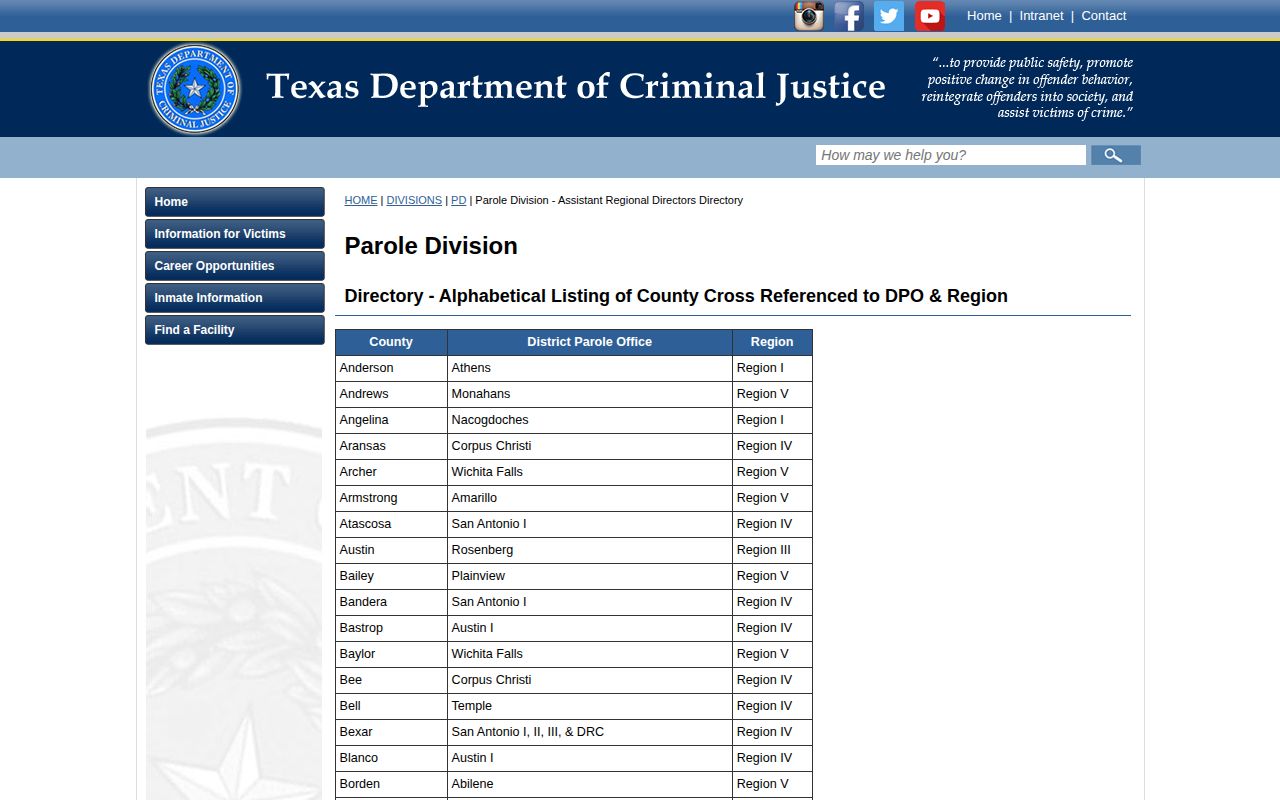
The directory identifies the starting office for a Young County parole inquiry, while an individual release record remains controlling.
Young County Parole Review Records
Ordinary Texas parole review is not a public Young County courtroom hearing listed on a county calendar. TDCJ identifies a case before the review point. An Institutional Parole Officer interviews the confined person and prepares a summary. A designated board office then routes the file through a three-member panel. Two matching votes make the decision, and a third member resolves a split. The BPP parole review process describes this administrative route.
The public Board meeting schedule concerns formal Board meetings. It is not a rolling list of named Young County people awaiting release. Nor did the research find a county-by-county archive of decisions for people already released. Before a vote, the status line is 844-512-0461. After a favorable vote, the TDCJ Parole Division release-status line is 512-406-5202. Callers should have a TDCJ number, SID number, or exact date of birth.
Decision codes also require care. FI-1 indicates release when eligible. Codes such as FI-4R, FI-9R, and FI-18R can require a program transfer and later conditional release at a stated minimum point. RMS refers to release to mandatory supervision. NR, serve-all, and denial of mandatory supervision are not release approvals. Some categories require a larger vote under Texas Government Code Section 508.046, but not every parole case receives full-board review.
Eligibility is only permission for BPP to consider release. Government Code Sections 508.145 and 508.149 set rules and exclusions based on such facts as offense, sentence, and offense date. Residence checks, treatment programs, special conditions, a records audit, certificates, date calculations, or detainers can still delay physical departure after a favorable vote.
Young County Supervision Warrants
Parole and probation conditions come from the order or certificate for that person. They may govern reporting, travel, programs, or other conduct. A claimed breach can lead to review, a warrant, arrest, or a court or agency response. It does not automatically establish a final violation. The responsible agency must verify both the condition and the current case status.
No general public list of every Young County parole or probation absconder was found in the official channels reviewed. Do not infer absconder status from a missed appointment, a failed name search, or secondhand information. Contact the Wichita Falls parole office for a state-supervision question. Use the Young County court and Adult Probation office for a local probation matter. TDCJ IVSS may send supervision-warrant notices to registered users when the state system covers that person.
Confirm the authority: A supervision warrant may return a person to custody, but only the issuing agency or court can confirm the warrant and its status.
Note: A new custody event does not erase the prior release; it creates another dated event that should be matched to the official record.
Switch Young County Notification Systems
Texas maintains two notification layers. Young County's sheriff page points to VINELink for participating local custody. TDCJ uses the separate Integrated Victim Services System, or IVSS, for state prison and parole data. IVSS notices can cover parole review, release to supervision, discharge, and supervision-warrant actions. A county VINE registration should not be expected to follow a person after transfer to TDCJ.
When the Young County release or transfer record names TDCJ as the receiving agency, use the TDCJ Victim Services and IVSS information and then register in the state portal if the person and event are covered. The division lists 800-848-4284 during business days from 7 a.m. to 6 p.m., 512-406-5900, and victim.svc@tdcj.texas.gov. Those contacts belong to the state notification route, not the Graham probation office.
The handoff is exact: local custody notice stays with VINELink, while TDCJ incarceration and parole notice belongs in IVSS.
How Young County Supervision Ends
Release and discharge are not synonyms. Parole release lets a person serve the remaining part of a state sentence under supervision. Mandatory supervision is another release path for an eligible state sentence. Discharge marks the end of the sentence or supervision obligation. Local probation likewise ends through the terms and authority of the court order, not because the person no longer appears on a jail list.
For a parole record, ask TDCJ or the assigned office for legally releasable status and discharge information. Parolee information inquiries may be directed to io@tdcj.texas.gov. For probation, use the cause number, judgment, later docket events, and Young County Adult Probation procedure. A fully discharged person may no longer have an active field-office assignment even though court and corrections history remains.
The cleanest record chain is short: release authority, supervision order, assigned office, and final discharge. Keep dates from each source. If they differ, determine whether one date marks approval, another marks physical release, and the last marks supervision or sentence completion. That approach avoids turning a stale roster or an old notification into a claim about current Young County supervision.
Note: Ask for an existing status or discharge record with identifiers; an office may not be required to answer an open-ended question.