
Young County Release Date Meaning
A projected date is an estimate produced while a sentence is being administered. TDCJ defines its “Projected Release Date” as the date calculated by the Correctional Institutions Division Classification and Records Office when an inmate is expected to leave incarceration if parole does not occur first. The offense title and offense date affect that calculation. It is not the same as a parole eligibility date, a maximum sentence date, or proof that a person walked out on that day. Each field answers a different question.
An actual release date records the custody event after it occurs. Even then, the destination matters. A Young County Jail entry may show an exit tied to bond, time served, dismissal, completion of a county sentence, or another court action. The same end to county custody can be a transfer to TDCJ, another county, federal authorities, or ICE. A transfer is not community release. The release sheet should identify the reason, authority, time, and receiving agency when those fields exist.
Find Young County Release Dates
The right lookup depends on where the person is held. Young County’s official jail page links a product labeled Current Jail List. It is not a release calendar. Its beginning-date box filters bookings, and a person still listed may have a blank release-date element. A person who is gone from the list has not, by that fact alone, been released to the community. Use the arrest or booking number to continue through the sheriff and court record.
For state custody, the TDCJ inmate search accepts a last name and first initial, a TDCJ number, or a SID number. Gender and race can narrow a match. TDCJ states that the online results include only people currently incarcerated in a TDCJ facility and that the information is at least one day old. That makes the displayed projected date useful before release, but the public result is not a lasting discharged-offender profile.
- Identify whether Young County Jail, TDCJ, or another agency now holds the person. Do not use a county roster for a state prisoner.
- Match the full name with date of birth, booking number, TDCJ number, or SID number. Avoid relying on a name alone.
- Read the precise field. Separate projected release, maximum sentence, parole review, court bond, and actual release.
- Check for another case, detainer, consecutive sentence, or transfer destination before treating the date as a community return.
- Confirm near the expected date with the current custodian and preserve the response or underlying record.
The broader Young County search and records workflow is available on the released-inmates home page. It connects the current list, sheriff release sheet, local courts, and receiving agencies without treating roster removal as final proof.
Note: The TDCJ public search may lag, so a displayed date or missing result should be checked through a direct information channel.
Young County Pretrial Release Dates
A pretrial detainee usually has no computed sentence-release date. The court may set bond, grant a personal bond, dismiss a charge, or issue another order that creates legal authority for release. That order does not guarantee an immediate jail exit. Bond still must be accepted, staff must process the release, and every other hold must be cleared. A second case, warrant, or outside-agency detainer can keep the person in custody after one case permits release.
Start with the roster’s arrest number and charge, then locate the court of jurisdiction. County-level misdemeanor records generally route through the Young County Clerk. Felony matters in the 90th Judicial District route through the District Clerk. Read docket events around the expected exit date and compare them with the sheriff timestamp. A bond order shows why release may proceed. The sheriff record shows when county custody ended and should reveal whether another custodian received the person.
- Bond
- Pretrial release under court-set terms while the criminal case ordinarily remains pending.
- Detainer
- A request or notice tied to another authority that may prevent community release or cause a transfer.
- Time served
- Credit that satisfies a custodial term as ordered; it does not by itself resolve every other case or condition.
- Discharge
- The end of a sentence, including any applicable supervision, in the technical TDCJ sense.
TDCJ Dates for Young County
A Young County conviction does not place a person in a “Young County prison.” No TDCJ unit is physically located in the county, and TDCJ assigns inmates statewide. While the person remains confined, the state result may show the unit, offense and sentence data, maximum sentence date, projected release date, and parole-review information. That state record, not Young County’s jail list, governs the state-prison projection.
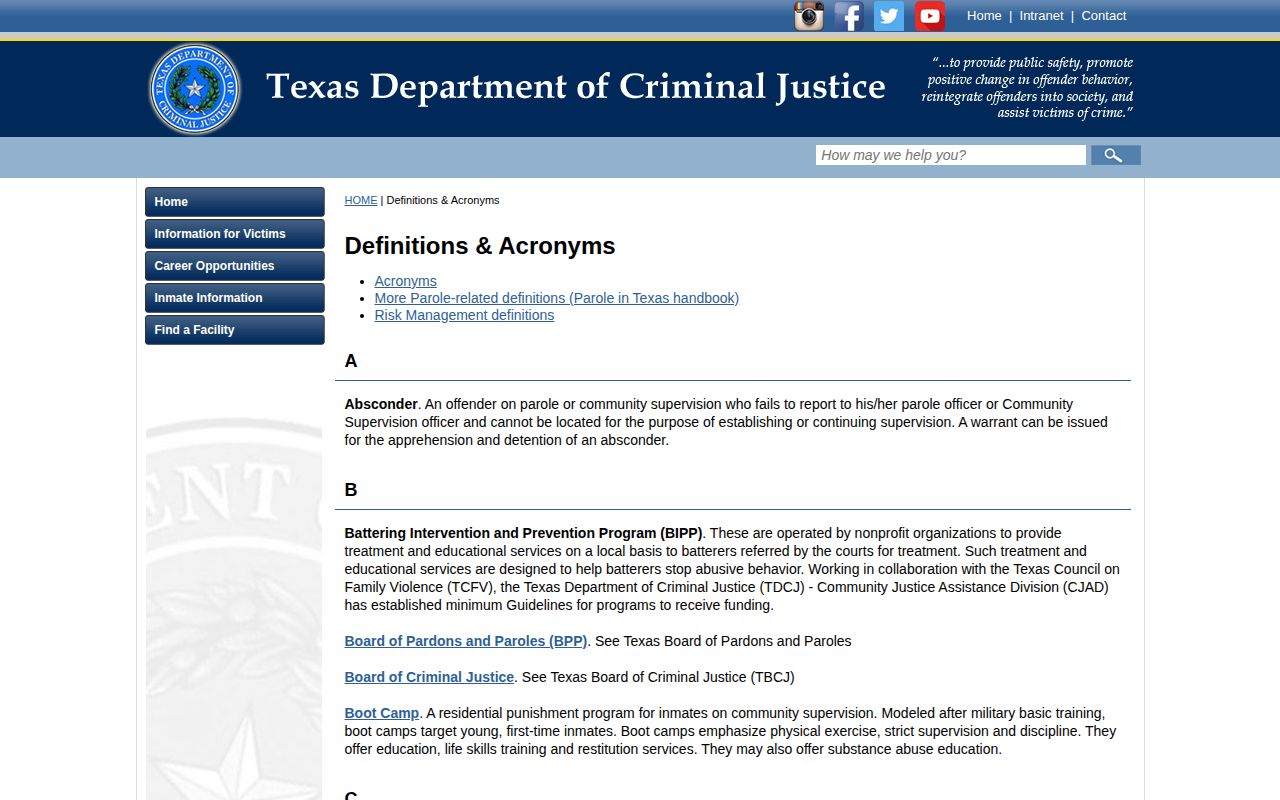
The distinction is visible in the TDCJ definitions source. The captured page below frames projected release and discharge as separate terms. That difference matters because a releasee can be out of prison on parole or mandatory supervision while the sentence continues.
After the person disappears from the current TDCJ search, use the agency’s information channels rather than inferring the outcome. The free email route asks for the full name and seven-digit TDCJ number. If that number is unknown, an exact birth date, or an approximate age and county of conviction, can help. Put the person’s name in the subject. TDCJ says the email service can provide specified incarceration and projected-date information, though it does not supply photographs.
Texas Good Time, Not 85%
Texas does not impose a blanket rule that every prisoner must serve 85 percent of a sentence. That shorthand should not be used to calculate any Young County case. For the group governed by Government Code Section 508.145(d), initial parole eligibility generally turns on actual calendar time equal to half the sentence or thirty calendar years, whichever is less, with a two-year minimum in the ordinary rule described by the research. Other convictions follow different provisions. Mandatory-supervision exclusions are separate again.
Under Government Code Chapter 498, good-conduct time is a classification-based credit. Class I can earn twenty days for each thirty days actually served, Class II ten, and Class III no regular credit. Trusty classifications can earn other statutory combinations. Discipline can cause forfeiture. The law says those credits affect eligibility for parole or mandatory supervision and do not otherwise reduce the sentence itself. State-jail felonies use the separate diligent-participation mechanism in Section 498.0032, which involves the sentencing court and cannot be replaced with an ordinary prison formula.
Offense date, the exact conviction statute, sentence structure, enhancements, and history can change the result. Mandatory supervision for an eligible older offense can produce a scheduled credit date when flat time plus good time equals the sentence. For eligible offenses on or after the statutory change, the Board of Pardons and Paroles must also approve discretionary mandatory supervision. A denial can move the projection to maximum expiration. Later approval can move it forward for processing.
Why Young County Dates Change
A projected release date is recalculated as the legal and custody record changes. Some changes are favorable, while others move the date later or replace the expected release with transfer. The following factors come directly from the Texas release framework and the Young County custody path.
| Factor | Possible effect | Record to check |
|---|---|---|
| Parole decision | Approval may permit release before the projection, but processing and conditions may remain. | BPP status, TDCJ release line, and Parole Division |
| Mandatory supervision | Eligibility and BPP action may move the date or leave maximum expiration in place. | TDCJ record and Government Code Chapter 508 |
| Good-time loss or restoration | Discipline or later restoration can alter the credit calculation. | TDCJ Classification and Records |
| Sentence correction or audit | Corrected jail credit, offense data, or consecutive terms can move the date. | Judgment, commitment, and TDCJ calculation |
| Detainer or other hold | The person may remain confined or move to another custodian instead of entering the community. | Sheriff or TDCJ hold and transfer records |
| Program or residence plan | Required completion or an approved plan can delay physical parole release after a favorable vote. | BPP and TDCJ release-status channels |
A favorable parole vote is not the same as a completed release. Residence review, a required program, special conditions, a release certificate, a records audit, and a detainer can all remain. For this reason, the final physical status should come from the current custodian or the post-vote release line, not from the vote term alone.
Note: A maximum sentence date, parole review date, and projected release date are separate fields and should never be reported as interchangeable.
Young County Jail Sentence Dates
TDCJ’s formula does not compute the end of a Young County misdemeanor jail sentence. Use the judgment, its jail-credit recital, the sheriff’s calculation, and any local credit that lawfully applies. The research found no official Young County jail good-time schedule and no published weekend-release rule. Importing the TDCJ Class I and Class II formula would therefore create an unsupported date.
Ask the sheriff for the calculated release date and the court for the judgment. A clear request supplies the full name, birth date, booking or arrest number, approximate booking date, and cause number. Seek the existing booking and release sheet, movement entries, release reason, authority, holds, destination, and receiving agency. The sheriff’s published page identifies Sheriff Travis Babcock as a direct starting point, but no dedicated records form, records hours, fee table, or promised response time was found.
The District Clerk record can show a felony sentence and credited time, yet the jail record is still needed for the actual exit. Another warrant may intervene. A transfer may follow. If the person is released to probation, the local court order and Young County Adult Probation office carry the post-custody trail. Probation is court-ordered community supervision and is not state parole.
Confirm Young County Release Dates
Near the expected date, use more than one record. For Young County Jail, call the Sheriff’s Office at 940-549-1555 and ask for the release date and time, disposition, authority, holds, and destination. If a copy is needed, submit a focused Texas Public Information Act request for the existing release and movement records. The Act requires prompt handling, but it does not create a universal ten-day production promise.
For TDCJ custody, the general information numbers are 936-295-6371 and 800-535-0283 during published weekday hours. The post-favorable-vote release-status line is 512-406-5202. Callers need a TDCJ number, SID, or exact date of birth. Texas IVSS serves the state-prison and parole notification path, while Young County’s sheriff-directed VINELink route serves participating local custody. The VINELink release check explains how to match the agency and status without merging those two systems.
Keep the exact language each source uses. “Projected” is not “released.” “Released from BOP” is not proof that no other custodian holds the person. “Transferred to TDCJ” is not a Young County community release. Those small distinctions produce a defensible answer when the date shifts or the public roster no longer shows the person.